Research Projects
| Mobile Environmental Sensing System Across a Grid Environment | |
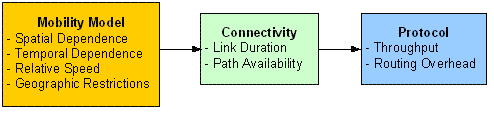
The above figure shows the research framework for analyzing the impact of mobility on the performance of communication protocols. By investigating the relationship between mobility and connectivity, we aim to provide a strengthened foundation for the future development of the communication protocols for Vehicular Ad hoc NETworks (VANET). In general, our responsibilities include the joint transport and communication modelling and the design of reliable protocol for data transfer.
1. Joint Transport and Communication Models
Objectives of Joint Models:
- Understand and exploit dynamics between vehicle movement and wireless communication capability
- Enable efficient design of vehicular ad-hoc network for transport systems control/managementIssues for Investigation:
- Develop joint mobility and communication models
- Communication connectivity among vehicles
- Identify strengths and weaknesses of vehicular networks2. Protocol Designs for Vehicular Ad hoc Networks
Issues for Investigation:
- Reliable protocols for data transfer
- Routing for disconnected bus ad-hoc network
- Optimal locations of road-side access points
- Cross-layer protocol and system optimisation
Links
References
[1]
F. Bai, N. Sadagopan, A. Helmy, "IMPORTANT: A framework to systematically analyze
the impact of mobility on performance of routing protocols for ad hoc networks,"
IEEE INFOCOM, Mar 2003. 
[2]
F. Bai, N. Sadagopan, B. Krishnamachari, A. Helmy, "Modeling Path Duration Distributions
in MANETs and Their Impact on Reactive Routing Protocols," IEEE Jounal on
Selected Areas in Communications, Vol.22, No. 7, Sep 2004.
[3] C. F. Daganzo, Fundamentals of Transportation and Traffic Operations, Pergamon Press-Elsevier Science, 1997.
[4] T. S. Rappaport, Wireless Communications: Principles and Practice, Prentice Hall, Englewood Cliffs, NJ, 1996.
[5] A. Jardosh, E. Belding-Royer, K.. Almeroth, S. Suri,"Real-world Environment Models for Mobile Network Evaluation," IEEE Journal on Selected Areas in Communications, Vol. 23, No. 3, Mar 2005.
[6] D. Son, A. Helmy, B. Krishnamachari, "The Effect of Mobility-Induced Location Errors on Geographic Routing in Mobile Ad Hoc and Sensor Networks: Analysis and Improvement Using Mobility Prediction," IEEE Transactions on Mobile Computing, Vol. 3, No. 3, Jul 2004.
[7] T. Camp, J. Boleng, V. Davies, "A Survey of Mobility Models for Ad Hoc Network Research," Wireless Communications & Mobile Computing, Vol. 2, No. 5, 2002.
[8] X. Hong, M. Gerla, G. Pei, C.Chiang, "A Group Mobility Model for Ad Hoc Wireless Networks," ACM International Workshop on Modeling and Simulation of Wireless and Mobile Systems (MSWiM), Aug 1999.
[9]
R. Mangharam, D. Weller, R. Rajkumar, P. Mudalige and F. Bai, "GrooveNet:
A Hybrid Simulator for Vehicle-to-Vehicle Networks", Second International
Workshop on Vehicle-to-Vehicle Communications (V2VCOM), Jul 2006.
| International Technology Alliance in Network and Information Science |
 |
(i) network theory
(ii) security across system of systems
(iii) sensor information processing and delivery and
(iv) distributed coalition planning and decision making
Our research work on Network Monitoring and Troubleshooting in MANETs evolves in Task 1 of Project 2 at Technical Area 1.
Network Monitoring and Troubleshooting in MANETs
The ability to monitor network components and troubleshoot when there is problem is one of the key elements to the reliable and robust operation of military mobile ad hoc wireless networks. Our main objective is to allow network operators to quickly identify suboptimal or abnormal behaviors of a network, and to correct the problem without requiring too much manual efforts.
The reason why it is difficult to analyze a performance problem in a multi-hop wireless network is that there may be multiple potential causes that interplay to produce observable symptoms. For example, consider a simple case when mobile nodes in a MANET cannot be reached. There can be many reasons for this symptom - the node's NIC may not function properly; the node may have moved out of range; there may be severe wireless link interference; or other intermediate nodes may be at fault. Furthermore, a problem in military networks should be understood in the operation environment. For example, in a densely deployed sensor networks, the failure of a single sensor node may not be critical, whereas in a tactical MANET, maintaining connectivity is of critical concern. The goal of this task is to develop efficient and scalable network monitoring/troubleshooting mechanism to enable the following:
- Fault localization and wireless root cause analysis
- Cooperative local monitoring of selfish behaviors and misconfigurations
- Proactive discovery of critical components that can be enforced to improve the overall
performance of the network.- Analysis of impact of network failure on quality of information
Links